Velocity One
The new shape of an agency website.
Design system as the leverage. Brand as the spec. AI in the publish flow. Velocity One is the first build out of the studio with all three moving at once.
Building an agency website looks nothing like it used to.
In 2020, an agency built a website by hand. Pages were designed in Figma, sliced into templates, and stitched together in WordPress or a headless frontend. Every new section was a small project. Every brand update was a round of cleanup. The work scaled with hours.
In 2026, the work scales with the system. The design system is the foundation, not a deliverable bolted on at the end. The brand is a spec the patterns read from. AI handles the volume side of publishing, so the studio and the editor focus on what only a human can do: judgment. Velocity One is the first build out of the studio with all three wired up end to end.


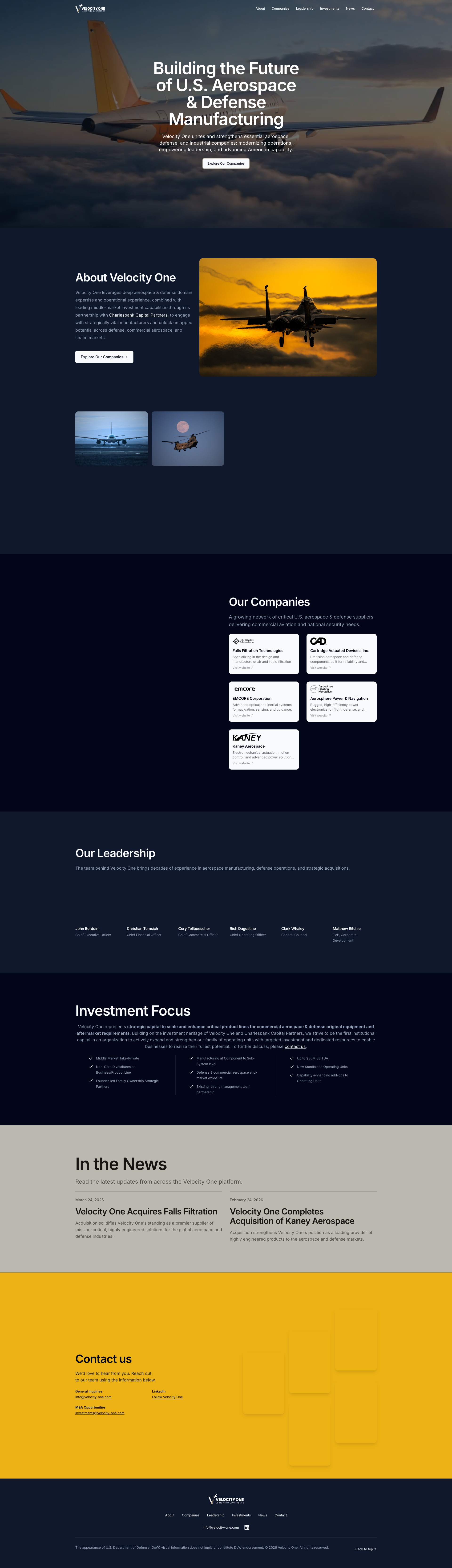
One long scroll. Seven sections. No filler.
The homepage opens on the cinematic hero, then runs through About, Companies, Leadership, Investments, News, and Contact in deliberate sequence. Each section uses a different layout from the pattern library; together they read as one continuous statement, not seven different decisions.


The brand is one PHP file the patterns read from.
Velocity One’s identity lives at the file level, not in a deck. brand-config.php holds the name, palette with named roles, type families, logo lockups, photography direction, and the tone-and-voice rules. The WordPress patterns render against it. The /design-system/ documentation renders against it. A Brand Settings admin page lets the operating team override defaults from one screen without touching code. Move the accent color in one place, the entire site shifts.
What follows is that spec, native, pulled from the source the site itself reads.
Design System
Asurmen Blue. Bright Orange. Quiet authority.
Navy carries 70% of the surface. Mist and silver fill 25%. Orange surfaces at roughly 5% on hover states, CTAs, and graphic highlights. The ratio is the discipline.
Color Palette
Asurmen Blue
PrimaryAsurmen Deep
PrimaryBright Orange
AccentBattleship Gray
SecondarySilver
SecondaryMist
BackgroundWhite Smoke
BackgroundInk
NeutralContrast Pairings
How the palette colors perform together — text on surface combinations ranked by contrast ratio.
Aa
White Smoke
Aa
Ink
Aa
Mist
Aa
Ink
Aa
Asurmen Deep
Aa
White Smoke
Aa
Asurmen Deep
Aa
Mist
Aa
Asurmen Blue
Aa
White Smoke
Aa
Asurmen Blue
Aa
Mist
Type System
Aerospace and defense holding company backed by Charlesbank
Aerospace and defense holding company backed by Charlesbank. Acquires and operat...
Aerospace and defense holding company backed by Charlesbank. Acquires and operates specialized component manufacturers across actuation, energetics, avionics, and power conversion.
Space Mono · 0123456789 · 400–700
Mencken Std
Section heads and editorial pull statements. Carries the institutional register.
Inter
Running copy, navigation, UI. Holds the screen from 13px caption to 22px lede.
Space Mono
Section folios, ledger labels, eyebrows. Carries the operator-brief feel.
Marks & Lockups
A system that grew with the festival.
What started as a wordmark in 2015 grew into a complete mark library — lockups, compact icons, laurels, anniversary seals, sub-brand treatments, and social assets. Each addition answered a real need as the festival expanded.
Full lockup · V monogram + wordmark + tagline
V monogram · favicon and small surfaces
Wordmark · default lockup
Wordmark + descriptor
Voice
How the brand sounds out loud — the tone every word inherits.
Write the way an operator briefs an investor. State the facts, then stop.
Lead with capability and continuity. Reassure the seller their company will be in capable hands.
Use concrete operational language. Name the discipline, the unit, the partner. Avoid soft language.
Restraint over rhetoric. No "transforming." No "unlocking value." No "world-class."
A WordPress Full Site Editing theme, on the studio’s terms.
The site ships as a custom Full Site Editing theme. Tailwind v4 generates the utility layer, shadcn semantic tokens hold the surface, and theme.json wires both into the block editor. The editor sees the system the same way the front end sees it. No double maintenance, no design-vs-implementation drift.
Eighty-nine block patterns sit in /patterns/. WordPress auto-discovers them at boot, so adding a new section is one file, no registration, no admin step. The Brand Settings page exposes the dials the operating team needs — accent color, logo, contact details — and parks the rest in code where it belongs.
A four-tier registry. Documented while it runs.
The /design-system/ reference is generated from the same registry the patterns render from. Brand documents the spec. Foundations holds tokens and the spacing scale. Components covers 7 primitives and 48 UI elements organized by category — Elements, Forms, Feedback, Navigation, Overlays, Data Display, Layout. Sections covers 74 page-level patterns and 9 full-page templates: heros, social proof, content splits, contact variants, pricing layouts, testimonial grids, CTA panels, blog rolls.
The Velocity One homepage uses about a dozen of those sections. The remaining sixty-plus are inventory for the next campaign page, the next portfolio company sub-site, the next investor brief. Pick a pattern, drop a section, publish.
Three custom post types, content-managed.
Company, Team Member, and Testimonial are registered as CPTs with admin columns and editor meta panels. The Companies grid, the Leadership grid, and the testimonial wall on the contact section all read from those collections. Editors add a portfolio company by filling four fields and uploading a logo. The pattern picks up the rest from the spec.
Once the system exists, the site builds itself.
AI in the theme, not bolted on.
When the editor hits publish, the theme runs AI through the publish flow. Alt text drafts itself on any image missing it. A 160-character summary writes for social and SEO. Suggestions for the meta description and the OpenGraph card show up in the post sidebar. The content gets embedded into a vector index for site search and retrieval. The editor sees one button.
The hooks are provider-agnostic. They are filters a child theme or a plugin connects to Claude, to the OpenAI API, or to a local model. The headless layer exposes the AI outputs over GraphQL if the client ever moves to an external frontend. The setup wizard turns it on with a checkbox. WordPress is doing more work than it used to, and the editor is doing less.
The work AI does. The work the studio does.
AI is good at volume. Drafting alt text for two hundred images. Writing a summary line that reads like the brand. Stamping out the thirtieth variant of a CTA panel. Indexing content the moment it ships. Generating the right field for the right pattern in the right voice.
AI is not good at judgment. What is the V1 origin story (every part must perform), and how does that line shape the about section? Is this photography actually the right register for the brand? Should the contact form read polite or terse? Which leadership names belong on the grid? Those are studio decisions. The brand spec, the pattern library, the photography direction, the writing rules: they come out of the room with the client, not out of a prompt. Once they exist, AI builds against them at scale.


You're in capable hands.
The site the client actually got.
Velocity One needed industrial calm: dark register, restrained motion, generous whitespace, no promotional language. The site has to convince a founder considering a sale that their company will be in capable hands. The design system carries that brief into every section. The AI hooks keep the site clean as the operating team publishes news, adds portfolio companies, and refreshes leadership bios over time. The studio ships the methodology with the project.
What are you working on?
Studio for founders, experts, and the institutions they run.
Living, working brands. Built with your team to keep growing.