
Button
Six variants (primary, secondary, accent, neutral, ghost, outline), three sizes, default and pill shapes.
Tokens
--primary--secondary--accent--radius-md--radius-full--font-primaryVariants
Sizes
Shape
State

We wrote the book on federal resumes.
Federal resumes. Books. Training. Certification.
Turning obstacles into opportunities for almost 50 years.
The Resume Place, Inc. was the first-ever federal resume writing service. Since 1973 we've seen a fair share of competitors and imitators, but there is only one original.
When The Resume Place was founded, we were essentially a design and print studio that employed storytellers to help people tell their unique career stories within the confines of a federal resume.
The internet did not exist, everything was done on paper, and people literally showed up at our door to get help. Some of us still remember the smell of ink, paper, and sweat when many eager job seekers would walk into our K Street office on a hot DC summer day.


The Resume Place is cut-and-dried but certainly not dry or dull.
Originators and Innovators
Over 50+ years of responding to Washington's changing rules, regulations, and culture.
Educators and Resource Center
Giving people the tools to transform their careers and their lives. Guiding leaders in finding the most qualified candidates.
Advocating for Changemakers
Empowering people to advance themselves by properly highlighting their talents, skills, accomplishments, and being their best selves.
“The Resume Place helps people write new chapters in their story of service and commitment to America.”
Federal job seekers, the federal employees and executives now moving into the private sector, and the agencies and trainers who carry the work forward.
Federal employee moving to the private sector
A current or recently separated fed facing a reduction in force, a reorganization, or plain uncertainty. They have a decade of real federal accomplishments and a resume built for USAJOBS, not for a private recruiter who reads it in six seconds. The move is not a step down. Their federal experience is the most valuable thing on the page, once it is translated.
SES candidate or senior leader, federal or private
A senior leader applying to the Senior Executive Service, or carrying executive-level federal experience into the private sector. The documents are heavier and the stakes are higher: ECQs, the five-page narrative, the two-page executive resume. They expect a partner who has written at this level for years and who treats their time accordingly.
Federal job seeker, GS-7 through GS-15
Someone with real accomplishments and no clear way to fit them into a federal resume. Mid-career or moving into government, facing OPM rules, GS levels, and a USAJOBS form that does not reward modesty. They want to serve, and they want the work they have already done to count.
Federal agency HR, procurement, or workforce-development lead
Responsible for finding qualified candidates and training the people already inside the agency. They buy SES ECQ workshops, trainer certifications, and curriculum on a government rate and a government timeline. They need a partner who has done this for decades and can show the receipts.
Ten Steps Certified Writer, Trainer, or Coach (CFRW, CFJST, CFCC)
An educator or career-services professional who teaches the federal job search using the Ten Steps curriculum. They earned their certification through the program and carry the methodology into resource centers, military transition offices, and private practice. They are both the brand's audience and its extension into the field.
The marks that hold the system together.
The Resume Place wordmark is the primary mark. The checkmark logomark is shorthand. They are documented as separate elements, and should rarely be paired together.


Finding our true colors.
For almost half a century, we've helped people further their careers and build a legacy in the service of our country. The brand's colors are as warm, vibrant, and sharp as the people who have come through our doors over the decades.
Select any step to copy its hex. The widest step in each ramp is the working default.
The palette mapped to intent. Values are copyable.
Balancing novelty and familiarity.
We have designed the secondary brand elements to give people a simple bridge from the old identity to the new, helping avoid confusion and giving them an opening to refamiliarize themselves with our brand.
Every role stacked the way it ships.
Photography selection, made simpler.
The following are some basic guidelines to help guide art direction decisions when planning a photo shoot, procuring stock photography, or browsing our back catalog of images.






Ask these of every photograph.
General use for all federal-career related content.
Training and consulting.

General use, publishing, and online learning.

General use for all career-related content. Military families and spouses.
Charismatic · Empowering · Plainspoken
Words we use
Words we never use
Ready-to-run prompts for anyone writing as The Resume Place.
Write a hero line for the {surface} aimed at {audience}. Lead with Resume Place's federal expertise since 1973. Plainspoken and charismatic, never hype or urgency. One sentence. No emoji, no exclamation points.
Write a 2-3 sentence intro for The Federal Career Newsletter on {topic}. Open with a plainspoken reframe of the reader's situation, then promise one specific, usable payoff. Audience: {audience}. Hold the warmth; respect the stakes.
Draft a short outreach email to {persona}. Name their exact situation in the first line. Offer the specific Resume Place service that fits (ECQ review, federal-to-private translation, certification). One clear next step. No false urgency, no generic flattery.
Rewrite this USAJOBS resume bullet for a private-sector recruiter who reads it in six seconds: {bullet}. Keep the accomplishment and scope. Drop the federal jargon. Lead with the outcome. Do not downplay the federal experience or frame the move as a step down.
Explain ECQs (Executive Core Qualifications) plainly to {audience}. Say what they are, why they matter, and what makes them hard, in three short sentences. Authority without jargon. Cite the OPM requirement if it sharpens the point.
Write the opening paragraph of a capability statement for {agency_lead}. Lead with proven curriculum and a credentialed trainer bench. Speak to procurement and compliance. Plainspoken, substantive, no marketing fluff. Show the receipts.
Curriculum + Certification Program
The Ten Steps shelf is one of the most prominent ways customers engage with The Resume Place, through the many book editions, training sessions, and the sheer wealth of information and opportunity associated with the brand. Familiar design elements from the previous Ten Steps brand (banners, stars, flags) are combined with new brand elements (color, logomarks) to enforce the connection between the Resume Place's legacy and its future.
Free tool, Resume Toolbox family
Part of the Resume Toolbox family. A simple encapsulation of the brand typography used for other familiar products and programming. The straightforward box motif around 'BUILDER' links the product back to the family of tools.
Agency training program
The executive leadership training offering for government agencies, delivered live and online. The mark ships in box, horizontal, and online variants so it can sit in course catalogs, slide decks, and the learning platform.
Learning platform
The self-paced learning surface: courses, videos, and the resource center that supports certification students and jobseekers between sessions.
Ten Steps to a Federal Job®


CCAR Accomplishment Builder

Executive Leadership Training Program (ELTP)


Resume Place Online Learning


Ten Steps to a Federal Job®
Legacy elements such as banners, stars, and flags are subtly utilized to invoke familiarity with the brand.
Badges are streamlined to be more of a solid design element that can be more easily utilized. Two tiers: Master Certified Trainer & Coach, and Certified Trainer & Coach.
CCAR Accomplishment Builder
A straightforward box remains as the primary motif around 'BUILDER' in the extended system, linking it back to the family of tools.
The main Resume Place logo letters serve as a simple encapsulated circle monogram, using a sturdier version of the brand's font.
Allows for acronyms and long titles.
Connects to the federal aesthetic and to other Resume Place programs.
CCAR Accomplishment Builder
Full-color business identity system. Print specs to be added.
Issued for Resume Place certification programs.
digital
Brand-aligned presentation template for workshops, training, and agency-facing decks.
Product and web surfaces apply the v1.1 identity under a stricter register, locked in 2026. The dark blues become the ground: Evening Blue and the night navy carry whole screens, not just headlines. Book-cover blue (#2F62C4), drawn from the Ten Steps covers, is the signal color for links, active states, and folios. Tangelo Orange steps back to an accent. It marks the one primary action in view and never becomes a surface.
Messina does the structural work. Serif for display, blue serif folios, condensed caps for labels and chrome, mono for data only. One primary button per view.
This is an application layer on the v1.1 identity, not a palette revision. Print, publications, and campaign work stay Tangelo-led as the book documents above.
Spacing
The brand's spacing scale and container widths. Mono-keyed for scan, not for memorization.
Radius
Corner-radius tokens. Small UI sharp. Large surfaces soft. Pills and avatars full.
Motion
Durations and easings. Conservative product-UI motion. Quick hovers, gentle transitions, no theatrics.
Component library
A token-driven component set. Every component reads from the brand scope above. Swap the brand and the same components reskin without code changes.
Six variants (primary, secondary, accent, neutral, ghost, outline), three sizes, default and pill shapes.
--primary--secondary--accent--radius-md--radius-full--font-primaryText input, textarea, and label. Standard size scale with hover and focus states tied to the primary token.
--primary--base-300--background--foreground--radius-mdDefault, soft, and outlined surfaces. Composable header, body, and footer regions.
--background--base-100--base-200--base-300--radius-lgStatus indicators and chips. Pulls from brand and status tokens for semantic meaning.
--primary--accent--success--warning--danger--radius-fullImage or initials, four sizes, optional brand tone for placeholder fills.
--primary--secondary--accent--neutral--radius-fullUnderline and pill variants. Active tab uses the primary token; inactive tabs sit at 60 percent foreground.
--primary--foreground--base-100--base-300How a page is argued
Every section on a The Resume Place page performs one job, and the job has a name that means the same thing on any site. Role is the universal layer, Section is what this brand calls the instance, Block is what renders it. A page spec that carries all three can be read by a writer, an agent, or a build without any of them knowing the other two.
Claim the page thesis and orient the visitor. First section, one per page.
What people call it in the room. Written in the brand voice, free to hide the role.
home-heroThe component that renders it. Swappable without touching the copy.
Fourteen roles, deliberately few. The ones The Resume Place leads with are marked; the ones it does not use are still listed, because a role this brand skips is a decision, not a gap.
RP earns attention with authority before it sells. Fifty years of federal hiring, the book that named the category, and a method that is visible before a price appears. Proof is not a band near the footer; it is load-bearing from the first line.
The home page in order. Read the role column alone and the argument is visible without knowing anything about The Resume Place.
openersegmentationprocessofferwhy-nowofferproofofferoffercatalogfreshnesscaptureclose
home-heroClaim authority in one line and orient the visitor.home-servicesName the three business lines in the reader's own terms, before any one of them is sold.home-methodShow how working with us actually goes: a certified writer interviews you and writes it, start to finish.home-startName the entry point, the paid consultation, and the two rates. Carries the audience cut inline rather than in a section of its own.home-rulesEstablish urgency: the guidance cut the federal resume to two pages and we already track every format era.home-interviewSell the second service: coaching before the interview.home-testimonialsProve it works, in clients' own words.home-certRecruit counselors into the train-the-trainer credential.home-agencySell courses to government agencies, over a wall of agency names.home-booksSell the shelf direct: a book for every stage of a federal career.home-newsShow the team publishing, current and expert.home-newsletterCapture the reader who is not ready to buy.home-ctaClose: work with the experts who wrote the Federal Resume Guidebook.Whatever its role, every section is written from the same named slots. The keys are house keys so any tool can read a spec. The right column is how The Resume Place speaks them.
kickerKickerThe small label above the headline. Wayfinding, not content.
Condensed caps live here and only here. Some brands say eyebrow; the spec key is kicker.
Set in Messina Sans Condensed caps. RP kickers are wayfinding only: 'How it works', 'Who we serve', 'For agencies'. They never carry the claim.
headlineHeadlineThe section's one claim.
One plain statement. Never restates the kicker.
One plain statement per headline, per the brand's Plainspoken rule. No two-part fragments, no accented half-lines.
ledeLedeThe opening paragraph. Earns the headline.
Present when the headline needs support, absent when it does not.
25 to 65 words. Names the rule, the document, or the window before it makes a promise.
bodyBodyRunning prose beyond the lede.
Story and about roles mostly. Most sections have none.
Rare on marketing pages. Lives in RP Resume News articles and the history narrative.
itemItemThe repeating piece: card, step, quote, stat, tier, question.
Each item has its own head and body pair. Named by the block noun.
RP names its repeating pieces by the block's noun, and the names are stable across the site.
figureFigureThe section media: photo, video, artwork, document.
Carries an alt and a credit. Never decorative filler.
Photography of real staff, classes, and books. The flag video is the one motion figure and it is chrome, not a section figure.
actionActionThe button or link the section asks for.
One primary per section, one primary per view.
One primary per view, set in Tangelo. Every service action leads to the same door: the paid consultation.
labelLabel / NoteChrome: prices, dates, folios, footnotes.
Mono is permitted here when the content is data.
Rates, GS grade ranges, credentials (CFJST / CFCC), editions, dates. Mono is permitted here because the content is data.
Named sections on the other pages. Roles repeat across pages on purpose: the same job, argued for a different reader.
section-statssection-cardssection-cardssection-ctasection-cardssection-media-splitsection-cardssection-media-splitsection-ledgersection-ledgersection-stepssection-ctasection-railsection-cardsnewsletter-formCanon: docs/SECTION_ROLES.md. This brand overlay: tokens/brands/<slug>/grammar.json, authored during the work like voice, never inferred. The coarser color axis on the sitemap diagrams is a tint, not a role; the two vocabularies sit at different altitudes and the map between them is many to one.
Composed patterns
The applied design studies, ported onto the platform and driven entirely by the tokens above. Two registers: the document stays ATS-quiet (ink, Messina, mono federal data); the frame carries the brand (navy ground, bright-blue signal, tangelo as a whisper).
Tangelo is rare: one primary action per view. Bright book-cover blue carries the signal; navy is the ground. Condensed handles acronyms and editions.
ButtonPillMono noteCondensed labelsONE tangelo action per view. Bright blue carries the signal. Navy is the ground.
The metadata a federal résumé must carry — series/grade, hours per week, salary, supervisor may-contact — set in Messina Mono as a bordered strip. The title is the one Serif moment in the document body.
Serif titleMono stripCondensed cell labelsFour labeled beats — Context · Challenge · Action · Result — so a hiring manager scans it in six seconds. Only the quantified result carries the bright-blue signal.
Serif folioCondensed beat labelsMono metricSignal blueLives only in the frame, never on the paper. Big thin-Serif match numeral in bright blue (same family as the marketing hero stats); covered keywords sit calm, a single required-but-missing term is the one tangelo whisper.
Serif numeralSignal meterMono keyword chipsTangelo gapReal screens
Composed pages built from the foundations, components, and patterns above. Live, not stills. The marketing homepage and the résumé workbench — the two surfaces the whole system exists to serve.
The marketing surface. The light editorial hero with its USAJOBS-ready preview card and serif proof stats, the navy Ten Steps books band with bright-blue covers, the "not dry, nor dull" character quote, the three-practice pillars, the core-services icon system, the articles and live-events bands, and the darkest-ground CTA. Navy is the ground; tangelo whispers once per view.
Fifty years inside the federal hiring system taught us how a resume wins. That expertise now works across the whole field, from the first federal job to the senior executive panel, and out into the private market.
The 2026 guidance rewrites how a federal application is supposed to read. We have tracked every OPM format era since 1973, so when a rule moves we already know what it means for your page.
Agencies are moving off the old five-page outline to a tight two-page format. Every accomplishment now has to earn its line. We have written to this length since the day it was announced.
Some announcements now ask for a short narrative in place of a duties list. It reads like a story and scores like a qualification. Most applicants have never written one. We have.
The new guidance pushes for skills-based, plain-language packages over jargon and acronyms. A clearer page that a human and an ATS both read the same way.
Drop your current resume up top, or come as you are. We read your roles, dates, series and grade. No blank form to fight.
One hour with a consultant who measures your history against the announcement and names exactly what wins the referral.
You get a finished, OPM-correct resume written to the current two-page format, not a template, not a wizard. Written for you.
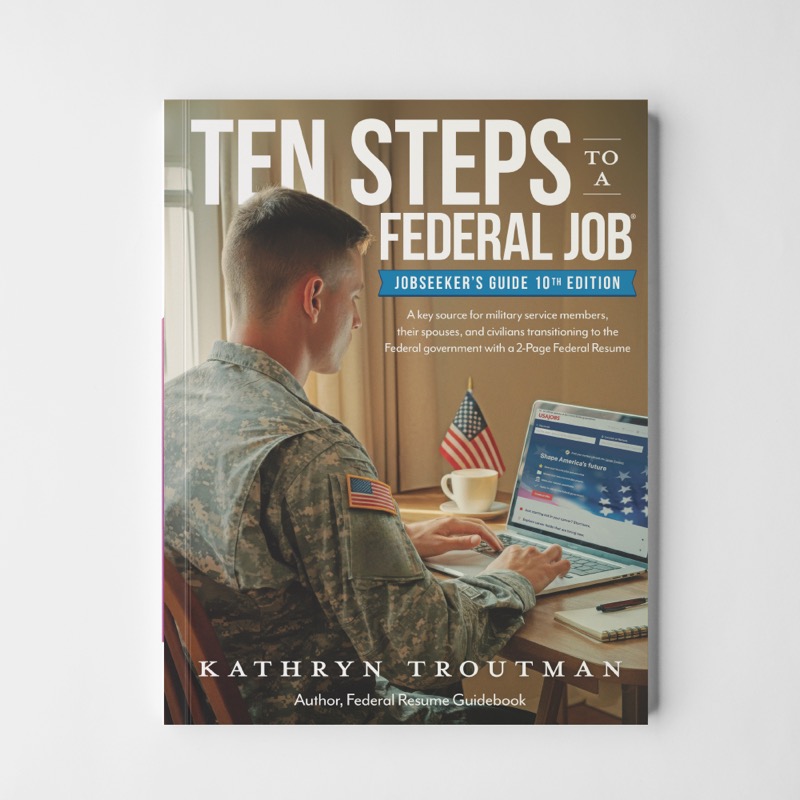
Ten Steps to a Federal Job® — the methodology agencies still train on, for military and spouses.
From$21.95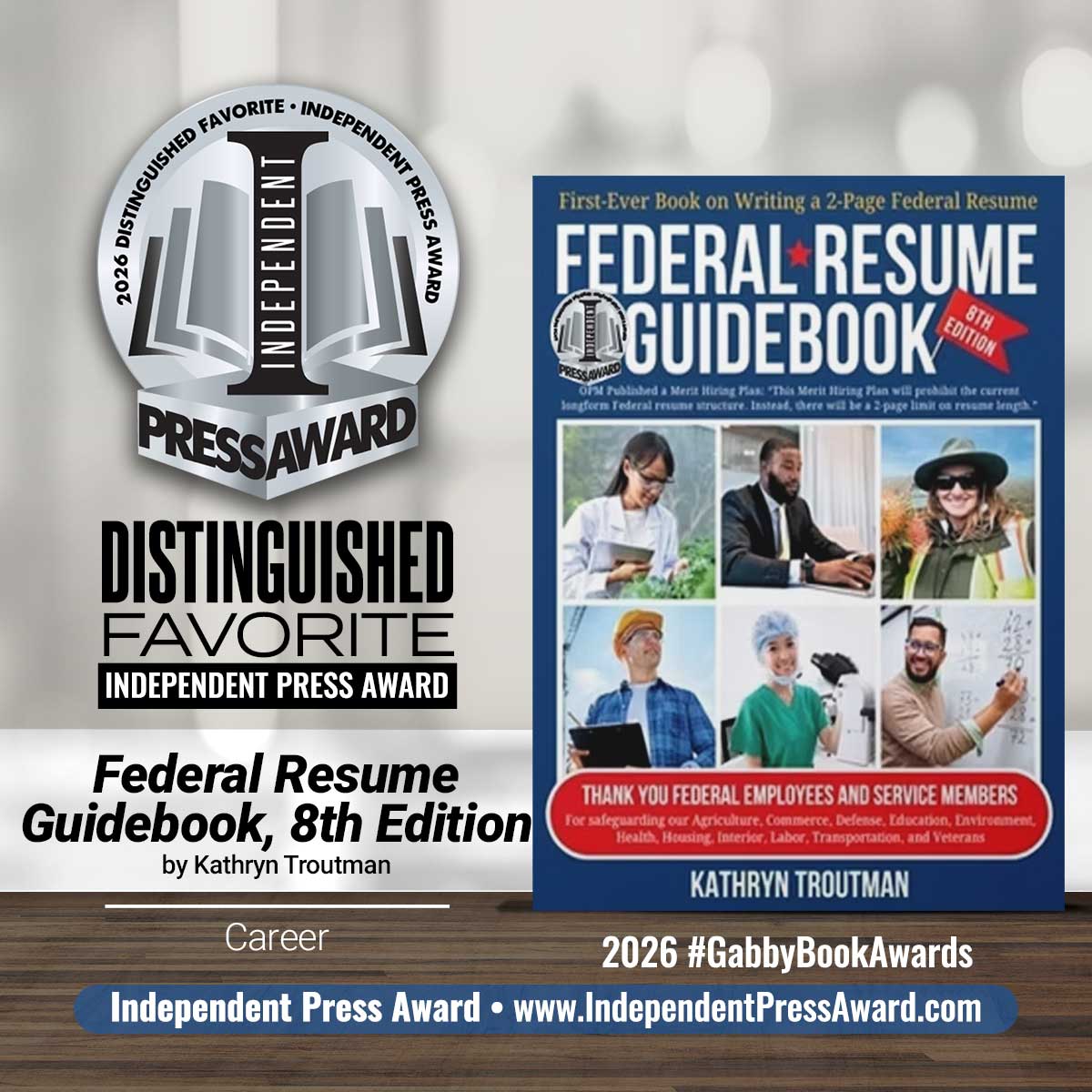
The book on the two-page federal resume. Keyword sets, accomplishment stories, real before-and-afters.
From$21.95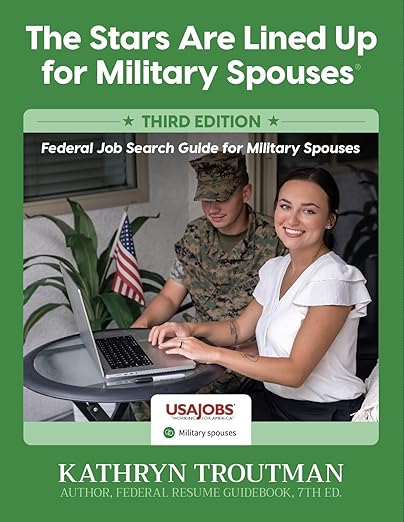
The federal job search for active-duty spouses: the four hiring paths and how to win on each.
From$15.95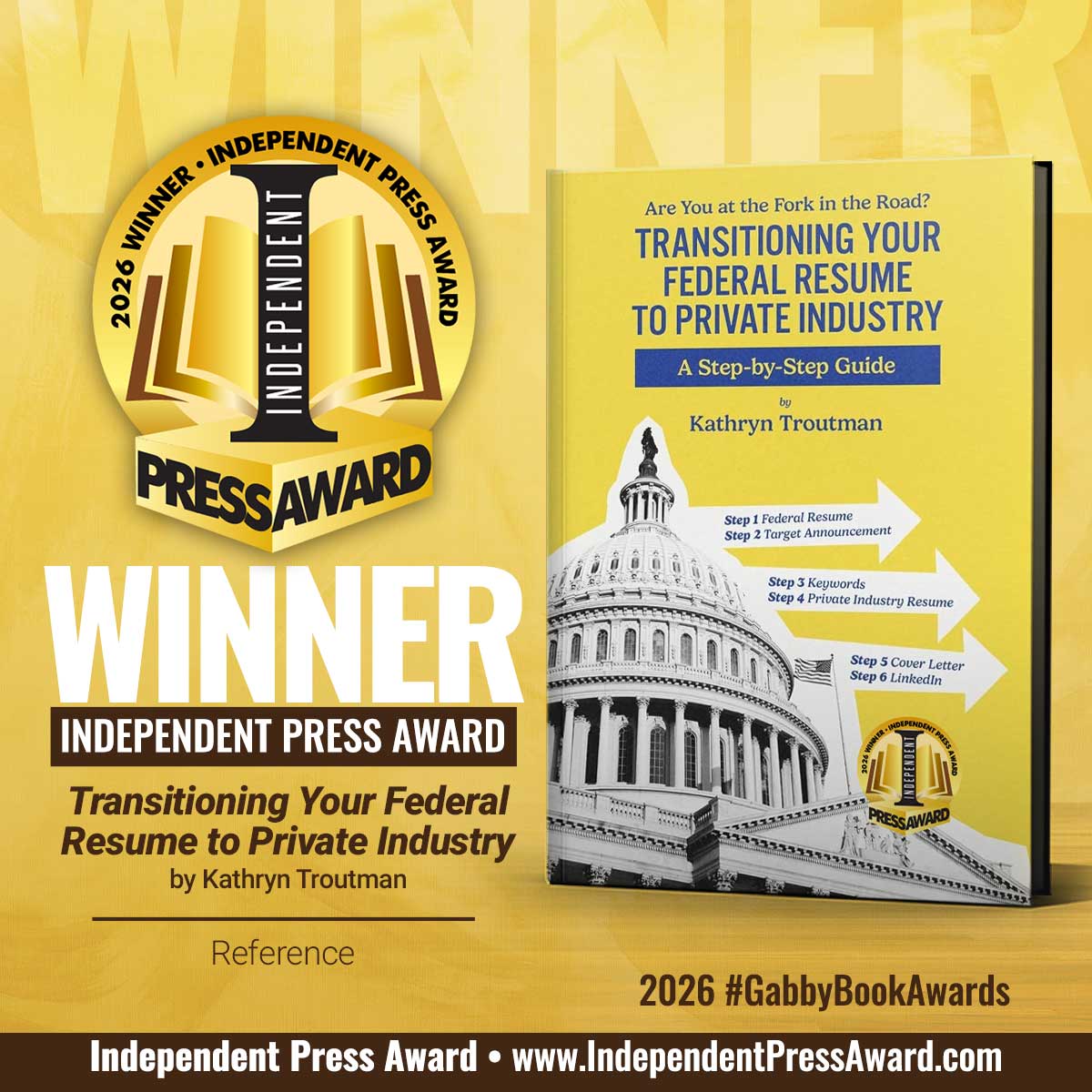
Moving between federal and private industry: how to convert the record so the other market reads it.
From$29.95Since 2002 we have certified career counselors, workforce staff, and HR teams to teach federal resume writing and the federal job search. A three-day program, train-the-trainer, with the books, the agenda, and the credential to run it yourself.
3-day certification · curriculum + license included
For workforce, employment, and transition counselors who teach the federal job search.
For coaches and HR staff who write and review the federal resume one-on-one.
Kathryn Troutman, the owner of The Resume Place, literally wrote the book on federal resume writing. Her personalized feedback and coaching has been absolutely invaluable in helping me receive more than a half-dozen federal job offers (and still counting). Particularly in a few instances when I feel I’ve hit a wall, Kathryn always seems to know what I’m doing wrong and how to fix my mistake.
We discussed and reworked my resume, also developing a suitable cover letter. I sent it out to four potential employers, and I was amazed to receive an outstanding offer the next day. True story, and I am grateful to Resume Place for the exceptional result.
Rita dedicated herself to understanding my concerns with my old resume. In under a week, she took my federal employment history with its disparate collection of duties and accomplishments and helped me craft an easy-to-read professional resume.
Before a key agency Senior Executive Service interview, Kathryn efficiently designed an interview simulation, application, and post-op review. Her no-nonsense guidance provided lifelong tips on the “Last 5 Percent” interview elements crucial to placement success. I could tell the positive difference during the extensive agency interview that followed.
The centerpiece, and the artifact at the center of the business. The two registers made visible: a disciplined ink-on-paper federal résumé (Serif masthead, Mono metadata strips, CCAR accomplishments with the win in bright-blue) held inside the expressive navy frame — match score, keyword coverage, format checks, and the one tangelo whisper on a missing required keyword. Runs on JSON Resume plus a federal extension.
Same colors and type as the marketing tile. The difference is discipline: inside the paper, the system goes quiet so a machine can read it. Around the paper, it speaks.
Inside the document: ink, one navy rule, no bleeds, no orange. If a machine can’t parse it, the design failed. The brand lives in the frame.
Grade, hours, salary, supervisor, dates. The fields that make a résumé federal are the fields that earn the monospace, set as a bordered strip on every job.
One signal color in the body, and only on a quantified result. Everything a hiring manager should catch in six seconds is bright-blue, nothing else competes.
The accent never decorates the résumé. It appears once, on a required keyword that’s missing, because the brand’s job is to point at the next thing to fix.


